
When We Look Away
What Fallout tells us about today’s press and the war in Gaza

One of the compelling reasons to read books is that they often take you to places you weren’t expected to be transported to. Sometimes there is a hint you may not totally see; sometimes it is a complete surprise. That was the case reading Fallout by Lesley M. M. Blume.
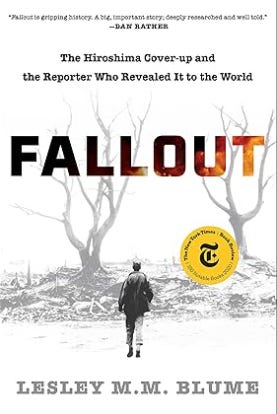
To read this book in 2025, it seems incomprehensible that media behaved in the manner that it did in 1946. And the first thought that comes to mind is could the New Yorker pull this off in 2025? Is the standard set by John Hersey, Harold Ross, and William Shaw, too high? More than the subject matter (I had already read Hirsohima) was how Blume details the meticulous manner in the way the story was vetted and edited. The way they kept the story secret to the entire staff-to the point of creating a “dummy edition” to fool the staff. This was a 30,000 word story, that was the sole story for that week’s edition. No cartoons, no “Talk of The Town.” Just the recounting of the bombing through the voices of six people on the ground. What is even more of a contrast to today is that they sent the story to a Manhattan Project leader General Leslie Groves to review before print. Groves made a few requests for changes that were agreed to. Is such cooperation a reality in today’s world?
It is the impact of the piece though, that kept my mind turning the most-in particular when I contrast it to the current war in Gaza. One of the consequences of the way the US government managed the bombings was that it reinforced the idea that while the atomic bomb was a brutal weapon of mass destruction, Japan had it coming. In the book there are multiple accounts of people referencing Pearl Harbor, Bataan, Tarawa, and photos of released GIs from Japanese POW camps. There was a trauma that affected Americans deeply enough to allow for a justification for the bombing (as well as a necessary evil to keep the US from suffering mass casualties if it decided on a land invasion). And it is here, I see a tragic similarity with regards to Gaza.
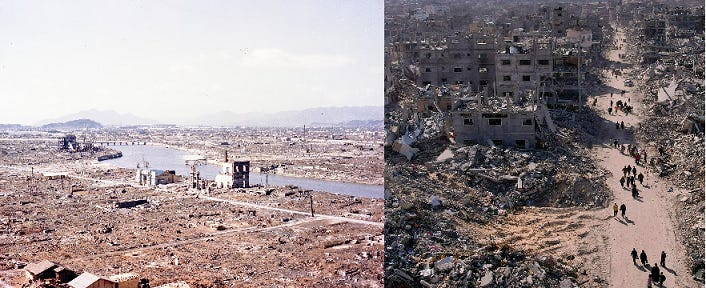
The trauma of October 7 was/is very deep. But one wonders today if the attack and the images that we all saw from Be'eri have become like those images from Tarawa that Americans saw in movie theaters, or the photos of POWs. Public opinion is fluid in Israel; we have seen protests and statements like the one from Ehud Olmert. But considering where we are today in Gaza, it is hard not to come to the conclusion that October 7 is not Israel’s September 11, but her Pearl Harbor. And in the death and destruction we see today, it has made a choice like the US made with Japan. What is tragic is that unlike in 1946, the images and stories have been there since the beginning of the war.
Perhaps that is why it is easier to look away today than it was then.